
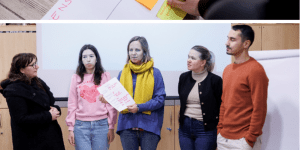
From 24 to 28 November, a local pilot training was held in Zagreb as part of the Erasmus+ project “Beyond Tokenism: Youth Leading Inclusion”, focusing on a phenomenon that many people do not even recognise — tokenism.
Many participants encountered the term for the first time, but as the training progressed it became clear that all of them had either witnessed or unconsciously practiced these patterns in their work.
When inclusion becomes an illusion
Tokenism is the practice of symbolically including people from marginalised groups in order to create the appearance of diversity and participation, without actually giving them real power or influence over decisions. It is when young people are invited to meetings, but their opinions do not shape the final outcomes. When their photos are used in projects, but they are not involved in planning. When they are given a voice, but not power.
Recognising and preventing such practices was the core focus of the five-day training led by Iwa Dugač, a qualified social worker. Participants came from the social sector, culture and education, and all of them work directly with young people in their organisations.
A five-day journey: from theory to personal practice
The first day was dedicated to creating a safe space. Through the activity “the web of connections,” youth workers shared their experiences and expectations, and a group agreement, personally signed by all participants, laid the foundation for open and honest exchange.
The real challenge began on the second day. A Mentimeter quiz revealed how much participants actually knew about tokenism — very little. That quickly changed. After the theoretical input, participants created a “timeline of tokenism,” recalling moments in their own lives when they felt excluded or marginalised. This exercise enabled deep personal reflection and connected theory with lived experience.
The third day introduced another key tool: Hart’s Ladder of Participation. This model distinguishes eight levels of youth involvement — from manipulation and decoration at the bottom, through tokenism in the middle, to genuine partnership and youth-led initiatives at the top. The activity “the privilege ladder” sparked intense discussions about how power and privilege shape opportunities for participation.
The hardest part: looking at one’s own practice
The fourth day was the most challenging. Participants were asked uncomfortable questions: “Where does my power come from?” “What are my privileges?” For many, it was the first time they had so directly reflected on their position within their organisations.
The “gallery of case studies” demonstrated what tokenism looks like in practice and how common it actually is. Importantly, participants realised that tokenistic practices often occur unintentionally. Someone may genuinely want to involve young people, but structural constraints, lack of resources, or simply not knowing better methods can lead to symbolic rather than meaningful participation.
In the activity “recognising tokenism in our own youth work,” participants critically analysed their own projects, identified “risk points” where tokenism is most likely to occur, and developed concrete prevention strategies.
Plans for change
The final day focused on the future. In the activity “redesigning activities,” participants reworked real projects from their organisations by applying principles of genuine youth participation. Young people were no longer just a “target group” but became co-creators. Instead of merely being “given a voice,” they were given decision-making power.
The personal reflection “what I take with me from this training” revealed the depth of learning. Participants did not only gain knowledge — they shifted perspectives. They learned to recognise their own biases, understand how their power position affects young people, and developed concrete action plans for their organisations.
The training concluded with a Youthpass ceremony, formally recognising the competences developed over the five days.
Why does this matter?
In a world full of projects “for young people” and initiatives that “include young people,” the question is not whether young people participate, but how they participate — and who really holds power. Tokenism creates the illusion of inclusion while maintaining the status quo. Young people remain objects of intervention rather than subjects of their own lives.
The Beyond Tokenism: Youth Leading Inclusion project seeks to change this — not only in Croatia, but across Europe. The Zagreb pilot training provided an opportunity to test the methodology in practice, to see what works and what needs adjustment.
For the 15 youth workers who took part, this is only the beginning. They return to their organisations equipped with tools to recognise tokenism, an understanding of power relations, and concrete strategies to promote meaningful youth participation. They developed clear personal and organisational action plans and formulated concrete commitments to apply these principles in their everyday work with young people.